
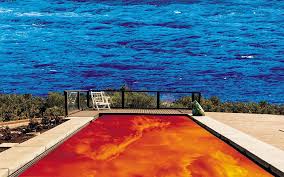
It has been a long time since I last wrote here. I apologize for my absence. I was really busy. The occasion to update is the 25th anniversary of Red Hot Chili Peppers’ legendary album, Californication. I’ve been listening to this album for exactly a decade. I first discovered the music video for the title track in the summer I graduated from primary school. The video game scenario impressed me, but Frusciante’s minimalist playing and Flea’s roaring bass lines in the chorus left a lasting impact.
Over the years, there were times I found the album too corny to listen to, but I always returned to it. The album continued to grow on me, and I expect this trend to perpetuate. Ten years ago, as a kid who could only play open chords on an acoustic guitar, I never imagined this album would inspire my bachelor’s thesis. The thesis prototype was a draft prompt I brought to the AMS Reinventing the City conference (see appendix). Being possibly the only bachelor presenter, I was surprised that my immature ideas received considerable praise.
After my presentation, someone asked how I managed to really ‘feel’ Los Angeles. I replied that I had been there, and more importantly, I could hear it. The geographical textures are implicitly embedded in every note and beat. Explicitly, the nature of Los Angeles is revealed by the lyrics, especially in Parallel Universe and the title track. The lyrics depict everything as upside-down or grotesquely arranged, echoing Charles Jencks’ (1993) summary: “heterogeneity over conformity, creativity instead of propriety, periphery at the center.” These properties are also visualized on the album cover, where water and sky have exchanged places. Intriguingly, this oddity was rectified on the B-side cover — is it as dialectical as Soja (2000) described in “Exopolis”?
Most fans don’t know that the album cover actually came from a dream Frusciante had. Californication is a tipping point in the band’s career as well as in Frusciante’s life, similar to how the emergence of the Los Angeles school marked a new epoch of urbanism. It signified maturity—the late phase of an individual, a place, and even a civilization. It’s a synonym for any “post”: postmodern, postindustrial, “Postmetropolis” (Soja’s book), etc. To understand the album, one must have a comprehensive view of Frusciante’s early years (you need to be modern before being postmodern), especially the Niandra Lades period. This year also marks the 30th anniversary of Niandra Lades and Usually Just a T-Shirt, the album I’d take to my grave. I will continue this discussion with a banger blog post on its release date, November 22. Stay tuned.
PS: I’m not going to post my thesis, as I expect it to be a long-term project. I will further delve into that topic in my master studies.
Appendix: presentation ppt and draft essay
 Fr7nkunst
Leave a comment